Insight
Orchestration is the new management


For a century, management meant coordinating people. Hiring them, motivating them, unblocking them, judging their output. The next century means coordinating people and AI agents - and it's the second half of that sentence where most leaders are quietly out of their depth.
Here's a claim plenty of managers won't like: a lot of what made someone a great manager of people transfers badly to managing agents. Different problem, different reflexes.
What orchestration actually is
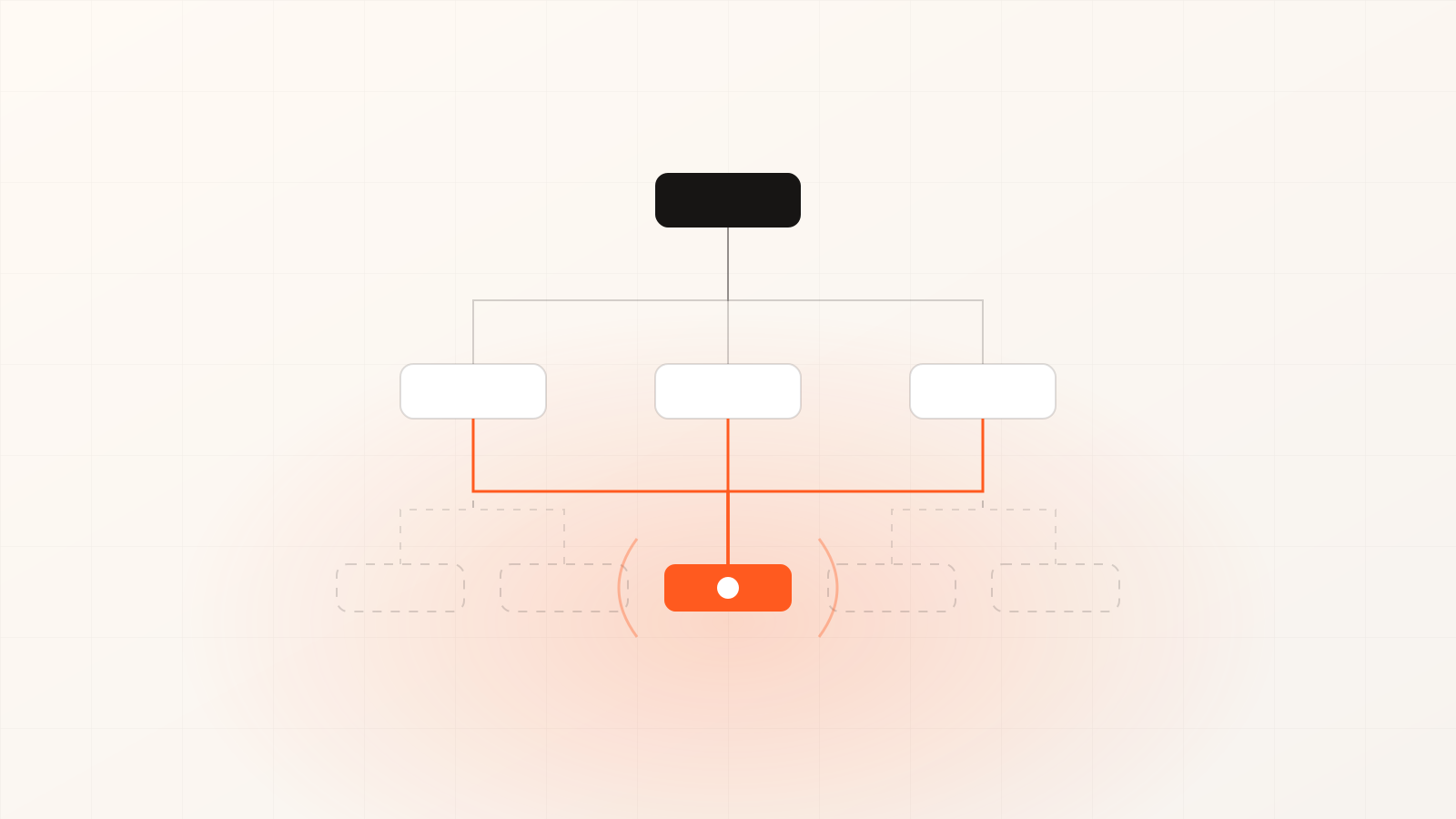
Orchestration is the defining capability of the Agent Boss. It means breaking an outcome into work an agent fleet can run, sequencing the dependencies, setting the guardrails, checking the quality and owning the result when it ships.
It rhymes with classic management. Delegate, coordinate, hold accountable. But the cadence is faster, the controls are different, and the judgement calls land in unfamiliar places.
Take the obvious one: trust. With a person, you extend trust and pull it back slowly, over months. With an agent, you decide up front exactly how much autonomy to grant, where the checkpoints sit and what it's never allowed to do on its own, then make that call again every time the work changes. Or feedback. You can't coach an agent the way you coach a junior; you rewrite the brief, tighten the context, and re-run. The skills look adjacent. They aren't the same.
And the scope shifts too. A manager of people might coordinate a handful of direct reports. An Agent Boss can be accountable for a fleet running dozens of tasks at once, around the clock, faster than anyone can watch in real time. That changes the job from supervising the work to designing the system that does it well without you in every loop.
Why it has to be learned deliberately
So where does orchestration capability actually come from? Not from using a chatbot, that's for sure, any more than you learn to run a team by sending a few emails. Messing about with a copilot builds familiarity, not capability, and I see the two confused constantly.
It's a distinct discipline, and like any discipline it can be named, measured and built. The Agent Boss Score makes orchestration capability for AI-native work visible - who can really do it, and where the gaps are. The AI Gym builds it the only way capability is ever built: deliberate practice on real tasks, not theory.
The alternative is to hope it emerges on its own. Some of it will, unevenly, in pockets, among the people who happen to enjoy tinkering. But hope is not a workforce strategy, and "we assumed our managers would figure out agents" is not a sentence anyone wants to repeat to a board.
The organisations that treat orchestration as a trainable discipline - rather than a thing that sorts itself out - will run leaner, faster and with a lot less drama. The ones that don't will keep promoting their best people-managers into roles that now demand a different skill entirely, then wonder why the agent rollout keeps stalling.